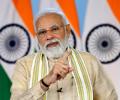
He asked to focus on the 'vocal for local' mantra during the 'Azadi ka Amrit Mahotsav' celebrations.

Seeking to spur foreign investments, Finance Minister P Chidambaram has said the Union Cabinet will decide on raising FDI caps in different sectors in the third week of this month.

West Bengal Chief Minister Mamata Banerjee has left no stone unturned this year after big industrialists, along with Union ministers, skipped attending the BGBS 2017.

Bob van Dijk, chief executive officer of Naspers, is now betting on companies in food tech, payments, travel and other consumer sectors to tap the potential of the Indian market.

The government is considering blocking internet protocol (IP) addresses of companies/exchanges on which trading in cryptocurrencies is happening, said a source in the know. Two months ago, the government had said it intended to bring a Bill to ban private cryptocurrencies and introduce India's own digital currency in line with what China and other countries had done. This move is part of that. The government had also proposed to promote technology like blockchain. Industry, however, says banning decentralised currencies like bitcoin and ethereum is not possible.

India's economy could prove to be the "most resilient" in the subregion of South and South-West Asia over the long term, according to a report by the UN, which says a positive but lower economic growth post COVID-19 pandemic and the country's large market will continue to attract investments. The report titled 'Foreign Direct Investment Trends And Outlook In Asia And The Pacific 2020/2021', and compiled by United Nations Economic and Social Commission for Asia and the Pacific (UNESCAP), stated that inward FDI flows to South and South-West Asia slightly decreased by 2 per cent in 2019, from $67 billion in 2018 to $66 billion in 2019. The growth, however, was mainly driven by India, which accounted for 77 per cent of the total inflows to the subregion and received $51 billion in 2019, up 20 per cent from the previous year.
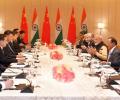
China had been trying hard to enter the Indian market, without opening its own to Indian products. There is an economic crisis in India-China relations that the Chennai Connect barely scratched the surface, points out Srikanth Kondapalli.

'Many non-resident taxpayers faced issues in filing Form 10F since the portal didn't allow those who didn't have PAN to file the form.'

There have been many efforts in the past to develop Mumbai into an IFC, while an expert group was also set up by the government years ago to study this possibility.

Foreign portfolio investors (FPIs) who invest from Mauritius into Indian companies that dole out bonus debentures will get impacted by the tax avoidance provisions on bonus stripping. The FY23 Budget has extended these provisions - applicable only to MFs, so far - to shares and units of REITs, InvITs and AIFs. The move will especially affect large institutional investors who sell original units within nine months after the record date because the loss arising from sale of original units would have to be ignored for the purposes of computing taxable income and cannot be set off against any other capital gain.

A fleet of eight JF-17 Thunder fighter jets -- jointly made by the two countries -- will escort the Chinese president once his plane enters the Pakistani airspace.

Embargo on imports from a neighbouring country would send a chilling signal to foreign investors who look for transparency and companies with manufacturing units in India had requested the government to publish any change in port policy "to provide the business community with the visibility they need to function", says United States-India Strategic Partnership Forum.

Brazil, Russia, India and China - popularly known as the BRIC nations - continue to be the hottest destinations for global investors, a new report from consulting firm Grant Thornton said on Wednesday

Of $90 billion remittances that India is expected to receive in 2022, only $27.4 billion has come in the first half of the year.

There is a lot of optimism across all markets and a large part of it is justified, says Samir Arora of Helios Capital Management.

IBM, Nokia Oyj, Microsoft cases could now be resolved

Making a strong case for approval of their proposed airline JV, Tatas and Singapore Airlines have said that the venture would create significant job opportunities in India and would boost the country's image as an international investment destination.

India's exports to China stood at $7.56 billion during the period whereas the imports have jumped to $52.26 billion in April-January

The company is planning to invest Rs 1,100 crore in the new mobile phone manufacturing facility.

The government on Monday extended the period of production-linked incentive scheme for large-scale electronics manufacturing with a focus on mobile phones by a year until 2025-26. The base year of the scheme 2019-20 remains the same but the companies will have the option to choose their five-year period either from the base year or the year 2020-21 for calculation of the incentives under the scheme. "Now we have extended the tenure of the scheme from 2020-21 to 2025-26. "Earlier, it would have ended in 2024-25.

They say better late than never. For the Tatas, the original owners of Air India, bringing back the airline to its fold is worth the wait even if the attempt to privatise the bleeding national carrier by successive governments has taken over two decades. While many airlines have come and gone from the Indian skies since the time when the first move was made to privatise Air India to date, the salt-to-software conglomerate has never let the love affair with aviation, more so with Air India that its former chairman Jehangir Ratanji Dadabhoy Tata (JRD) had, to go off the radar. It is said that Tata group executives used to complain in private that JRD -- the pioneer of the Indian aviation industry -- spent more time worrying about Air India than the Tata group when he was heading both the entities.
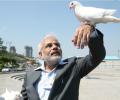
NPA issues in the banking sector, standoffs in Parliament denting the reform momentum and limited space on the fiscal side are among the major concerns for investors.

Singapore continued to be the largest source of FDI in India followed by Mauritius, the US, the Netherlands and Japan.

Prime Minister Narendra Modi on Friday said his government has within 100 days in office steered the economy out of a "difficult situation" and brought stability, and promised to remove roadblocks to foreign investment.

A stable government at the Centre and its plans to set up smart cities has revived investors' interest in the country with Mumbai, Delhi and Bangalore set to emerge as hot investment destinations in 2015.
.jpg)
The Tata Group says it is bullish on investment in India.
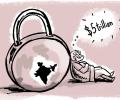
Foreign Direct Investment (FDI) is critically important for India to become a $5 trillion economy, Deloitte CEO Punit Renjen said while noting that over two-fifths of the 1,200 business leaders surveyed in the US, UK, Japan and Singapore are planning additional or first-time investments in India. Referring to the survey, he said India continues to be "one of the most attractive" FDI destinations. "Despite the COVID-19 destruction, inflows hit a record high last year. "Business leaders, whom Deloitte surveyed, are preparing to make additional and first-time investments in India," Renjen said.

Bharti Airtel chairman Sunil Mittal has expressed hope that the government and regulators will step in to ensure the sector remains a viable place for continued investments and asserted that the industry requires "long overdue" support to maintain its current 3+1 structure. In the latest annual report of Airtel, Mittal said as the sector's role in the economy becomes more pervasive, its challenges loom larger. Issues such as unsustainable pricing and low returns in a highly capital-intensive environment, coupled with legacy legal issues, "have extracted their toll", Mittal observed.

Eyes investments of Rs 31,000 cr in research and manufacturing of electric vehicles
The PE biggie has committed to pumping money into Jio Platforms, Byju's and Reliance Retail so far this year - all marquee names in their respective sectors.

Prime Minister Narendra Modi arrived in Abuu Dhabi on Sunday on a two-day visit to the strategically important United Arab Emirates during which he will hold talks with the country's top leadership to enhance cooperation in key areas of trade and security and address the Indian diaspora.

'Since the NDA took office in 2014, and aggressively since 2019, the Union government seems hell bent on centralising all power and resources, only to fail spectacularly.'

The new norms provide an operational framework for FPIs, a new class of overseas investors that club all existing class of investors like foreign institutional investors and Qualified Foreign Investors.

Uber Technologies said it is doing a fresh round of recruitment for its India tech centres and is planning to hire 500 more tech employees by December. The app-based mobility and delivery company has a 1,000-member tech team across its centres in Hyderabad and Bengaluru. The firm said the hiring plan is a testament to Uber's commitment to India, and its recognition of the engineering talent in the country. Uber hired 250 engineers to its India teams in 2021.

Walk down the pathway of improved habits like regular exercising, a balanced diet and sufficient sleep with your partner.

News, as a business, faces its biggest crisis ever, globally. To fight it needs investment in feet-on-the-ground journalism, tech tools like artificial intelligence among other things.

Prime Minister Narendra Modi addressed the nation from the ramparts of Red Fort in New Delhi as India celebrates the 72nd Independence Day. This is Modi's fifth and final address as PM in the current tenure. During his speech, Modi reflected on the achievements of the National Democratic Alliance government and presented a report card of his four-year tenure. Here are the main takeaways from his address:

In a wide-ranging overhaul of rules to make India an easier, safer and attractive investment destination, Sebi on Tuesday unveiled a new set of streamlined entry norms for foreign investors, while putting in place checks against any wrongdoings by the company promoters.

'I'd define my personal style as comfy, timeless and easy going.'

Nomura Group Study found that in 2019, out of the fifty-six companies which shifted their production out of China, only three of these invested in India; while 26 went to Vietnam, 11 to Taiwan, and 08 to Thailand. In April 2020, Nikkei noted that out of the 1,000 firms which were planning to leave China and invest in Asian countries, only 300 of them were seriously thinking of investing in India.
